Is Honey Vegan? What It Is, Why Vegans Avoid It and What to Bake With Instead
Honey is food that bees make for their own colony, which puts it outside a vegan diet. Here is how it is made, how US labels name it, and how maple syrup, agave and molasses stand in for it in baking.
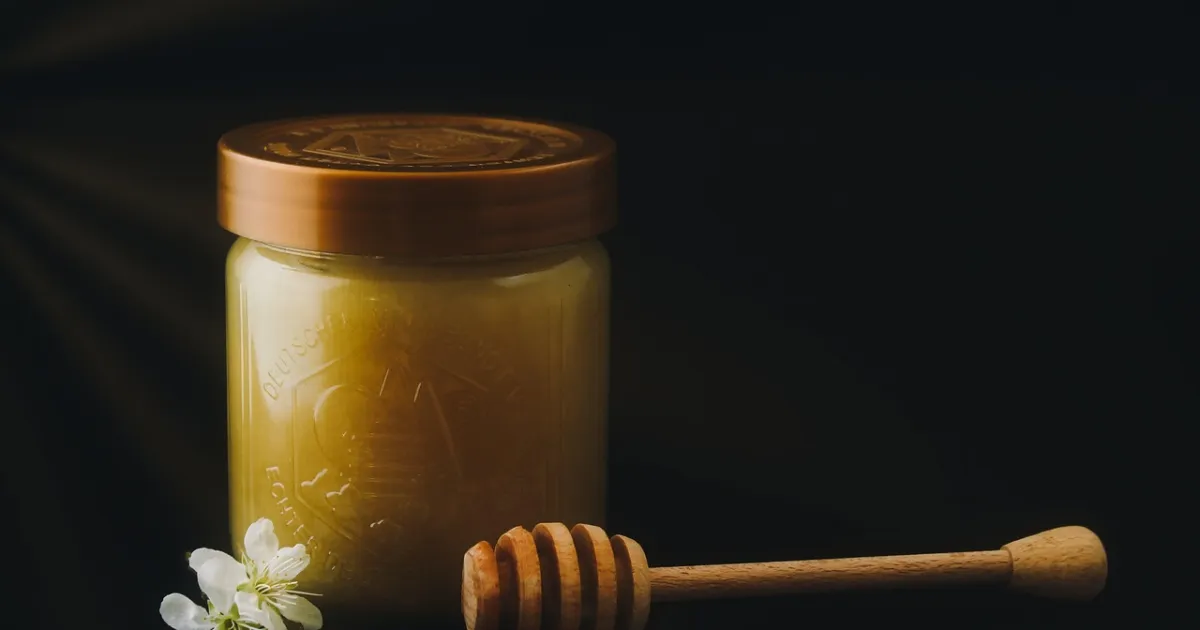
No. Honey is made by bees, from nectar they collect and process to feed their own colony, so it is an animal product and falls outside a vegan diet as The Vegan Society defines it. For a baker it is one of the easier ingredients to replace: maple syrup, agave syrup and molasses are plant-based liquid sweeteners that behave in much the same way in a batter or dough.
What honey is and how bees make it
The FDA's labeling guidance for honey, issued in 2018, adopts the ordinary dictionary meaning: a thick, sweet syrup made by bees from plant nectar and stored in honeycombs as their food. The steps in between explain why it counts as an animal product and not a plant one.
A foraging bee sucks up nectar, which is 70 to 80 percent water, and carries it in a separate honey stomach. Enzymes secreted by the bee begin splitting the nectar's sucrose into glucose and fructose. Back at the hive the forager regurgitates its load and passes it to hive bees, which work it in their mouthparts to drive off water and then place it in wax cells. Beating wings move air across the open cells until the water content falls to roughly 15.5 to 18 percent, and the bees seal each cell with a wax cap.
The quantities are small. According to The Vegan Society, a honey bee may visit up to 1,500 flowers to fill its honey stomach, and a single bee produces about a twelfth of a teaspoon of honey in its lifetime.
Why vegans leave it out
The Vegan Society, the British charity whose founders coined the word vegan in 1944, defines veganism as a way of living that seeks to exclude, as far as is possible and practicable, "all forms of exploitation of, and cruelty to, animals" (The Vegan Society, Definition of veganism). In dietary terms the same definition rules out every product derived wholly or partly from animals. The Society's early manifesto named honey next to eggs and milk.
The Society's page on the honey industry gives its reasons. Honey is the colony's energy source, and bees rely on it through poor weather and winter. When beekeepers take it, the Society says, they replace it with a sugar substitute that lacks honey's micronutrients. The page also objects to selective breeding for higher yields, to clipping the wings of queen bees so that they cannot leave to start a new colony, and to the culling of hives after harvest to keep costs down.
Those are the Society's descriptions of conventional beekeeping. For someone reading a label the rule is shorter: under the definition, a food made by an animal is excluded however it was collected. The same reasoning covers other things bees make. Beeswax, which carries the additive number E901 on European labels, is not considered suitable for vegans either.
How to spot honey on a label
US labeling rules make honey easy to find, provided you read the ingredient list and not only the front of the package. Under the FDA guidance, a product that contains nothing but honey must be named honey, and it needs no ingredient statement because it has a single ingredient. The name may include the floral source, as in Clover Honey.
In a food with several ingredients, each one has to be listed by its common or usual name in descending order of weight, so honey appears as the word honey. A syrup that mixes honey with another sweetener cannot be sold as plain honey; the FDA's example of a correct name is Blend of honey and corn syrup.
One thing the label will not do is flag honey for you. The allergen statement that begins with Contains covers only the nine major food allergens (milk, eggs, fish, Crustacean shellfish, tree nuts, peanuts, wheat, soybeans and sesame), and honey is not one of them. Check the full ingredient list of any sweetened baked product, sandwich loaves included. Our guide to whether bread is vegan covers the other ingredients worth looking for there.
What to bake with instead
In a recipe honey sweetens, adds liquid and speeds up browning. Three plant-based syrups do the same work, each with its own flavor.
| Sweetener | What it is | Compared with honey |
|---|---|---|
| Maple syrup | Sap of the maple tree, concentrated by heat to at least 66 percent soluble solids under the federal standard of identity | About as sweet as sugar, so slightly less sweet than honey; browns less quickly |
| Agave syrup | Juice from the core of the agave plant, filtered, heated and concentrated | Slightly thinner; blue agave syrup is rated 1.4 to 1.6 times as sweet as sugar |
| Molasses | The dark syrup left over when sugar is refined from cane or beet juice | Less sweet and far stronger in flavor; best used in small amounts |
Replace honey with the same volume of maple syrup or agave syrup: 1/4 cup (84 g) of honey becomes 1/4 cup of maple syrup (78 g) or of agave syrup (84 g). King Arthur Baking, which tried honey, maple syrup and molasses in place of sugar (it did not test agave), says to expect similar results whichever liquid sweetener is used, with slight differences in flavor and color.
Adjusting a recipe written for honey
Sweetness is the first difference. King Arthur calls honey the sweetest of the common liquid sweeteners and uses about 3/4 cup of it in place of 1 cup of sugar, while maple syrup replaces sugar cup for cup. A cookie or muffin made with maple syrup will taste a little less sweet than the honey version. If you miss the sweetness, about 1 tablespoon (12 g) of sugar for each 1/4 cup of syrup closes most of the gap.
Browning is the second. Honey browns quickly because of the glucose and fructose it contains, and King Arthur advises against using it in recipes baked above 350°F (175°C) because it scorches. Maple syrup browns less quickly than honey, though slightly faster than granulated sugar. Keep the oven temperature the recipe gives, expect a somewhat paler crust, and judge doneness by the recipe's own test, not by color.
Molasses is a partial substitute. It is not as sweet as honey or maple syrup, it can have bitter undertones, and very dark blackstrap molasses can turn bitter when baked. Use it for part of the honey in spiced doughs such as gingerbread cookies, where its flavor belongs.
You can also go back to dry sugar. King Arthur's rule for putting honey into a sugar recipe is a generous 3/4 cup of honey for 1 cup of sugar, with the other liquid reduced by 3 to 4 tablespoons. Run backward, that gives 1 cup (198 g) of sugar plus 3 to 4 tablespoons (43 to 57 g) of plant milk or water for each 3/4 cup (about 250 g) of honey. Treat it as a starting point. Whether refined sugar itself is vegan is a separate question, answered in our article on sugar.
Questions
Is raw, local or organic honey vegan?
No. Those words describe how the honey was handled or where it came from, and it is still food made by bees. The Vegan Society's objection is to taking honey from the colony at all.
Is beeswax vegan?
No. Like honey it is produced by bees, and insect products of this kind are not considered suitable for vegans. In an ingredient list it appears as beeswax or, on European labels, under the additive number E901.
Is maple syrup vegan?
Maple syrup is the concentrated sap of the maple tree, a plant product. The federal standard lets producers add salt, chemical preservatives and defoaming agents as optional ingredients, so ask the producer what defoamer is used if you want to be certain.
Is agave syrup vegan?
Yes. It is made from the juice of the agave plant and is widely used as a honey alternative by people who follow a vegan diet. It is a little thinner than honey, and blue agave syrup is rated 1.4 to 1.6 times as sweet as sugar.